Video Analysis
Global financial markets are facing significant headwinds due to escalating geopolitical tensions in the Middle East, rising oil prices, and renewed inflation concerns. Asian stocks are experiencing a second day of declines, while US Treasury yields are climbing. Discussions also cover Iraq's currency devaluation, EU-China trade disputes, and mixed signals from the AI sector's credit risk and IPO activity.
- Houthi attacks in Saudi Arabia and a tanker attack in the Persian Gulf are driving oil prices higher, with Brent crude above $102.
- Asian stocks are falling for a second day amidst inflation jitters, with Samsung's record profit failing to impress investors due to missed estimates.
- Iraq devalued its currency by 13% as Strait of Hormuz disruptions impact oil exports, while the EU is considering import caps on Chinese hybrid cars.
- US Treasury yields are rising, reflecting hawkish central bank sentiment, and concerns about AI credit risk are increasing despite strong demand for memory chips.

Oil and European gas prices are climbing due to reports that the US is considering military strike options against Iran, potentially before the midterm elections. This comes amidst escalating attacks by Iran on vessels in the Strait of Hormuz and Houthi groups on Saudi infrastructure, adding a significant geopolitical risk premium to energy markets.
- US White House reportedly asked the Pentagon to draw up military strike options against Iran.
- Attack could be executed before US midterm elections, according to The Atlantic report.
- Iran has escalated attacks on ships in the Strait of Hormuz, and Houthi groups have intensified strikes against Saudi airports and oil infrastructure.
- Markets are interpreting these developments as a risk of broader regional escalation, leading to higher oil and gas prices due to potential supply disruptions and infrastructure damage.
Kevin Hassett, former White House National Economic Council director, discusses President Trump's economic policies, highlighting the invocation of the Defense Production Act for various sectors and tax incentives that led to an 'explosion of investment' and job creation in U.S. manufacturing. He contrasts this with Democratic 'tax and spend' approaches, emphasizing free enterprise. Trump also teases future announcements, particularly regarding American shipping.
- Trump's policies, including tariffs and tax cuts allowing expensing for new factories, have led to significant domestic investment and job growth.
- Almost 400 factory groundbreakings and 110,000 new factory construction jobs are cited as evidence of economic success.
- Future announcements are teased, with a specific mention of American shipping as an area of focus.

Long-time bond bear Jim Bianco has turned bullish on bonds, arguing that current 5%+ yields across the curve now reflect economic fundamentals and offer fair value. He recommends buying bonds from the 5-year maturity onwards, viewing the current rate environment as a return to normalcy after an abnormal decade.
- Bianco is positive on bonds for the first time since 2020, stating 'math works again' at current yields.
- Benchmark 10-year Treasury yield in the 5% range finally reflects a 'normal' 5% nominal economy (3% inflation + 2% real growth).
- Bonds are no longer expensive and offer value, with buying opportunities from 5-year maturities and longer.
- While some low-rated corporate credits face refinancing challenges, overall corporate debt has been deleveraging, and the market can handle current levels.

Willy Walker discusses the booming data center market, highlighting massive capital investment and local pushback. He also addresses the broader commercial real estate market, noting a significant wall of maturing debt, rising interest rates impacting deal re-trades, and a looming supply shortage in office and multifamily sectors, despite current financing challenges.
- Data centers are experiencing a massive boom with 2,000 projects in planning and $800 billion in hyper-scaler investment by 2026, despite growing local moratoriums.
- Commercial real estate faces a $1.5 trillion debt maturity wall in multifamily over the next four years, with rising rates leading to deal re-trades and borrowers seeking shorter-term financing.
- While debt capital is abundant from agencies, private equity, and life insurers, equity capital for new construction is currently scarce, leading to future supply constraints in office and multifamily.
The discussion centers on the significant risk posed by a hurricane threat in the Gulf of Mexico to an already pressured energy market. With refineries running at full capacity and global refining capacity already offline due to geopolitical events, any disruption could lead to temporary price spikes for gasoline and diesel, and potentially impact crude oil production, keeping energy prices structurally elevated.
- Hurricane threat in the Gulf of Mexico poses a significant risk to gasoline and diesel prices due to already tight fuel inventories and refineries running flat out.
- Roughly 2 million barrels/day of refining capacity are potentially in the storm's path, adding to the 9% of global refining capacity already offline.
- While temporary, any disruption could cause price spikes, and the rebuilding of global stock piles could take up to two years, providing a floor of support for elevated prices.
The Federal Reserve's September meeting minutes revealed unanimous support among all 19 FOMC members for the recent rate hike, driven by elevated inflation and upside risks. Many participants anticipate another rate increase by year-end, as the current policy is considered only mildly restrictive despite solid economic growth.
- All 19 FOMC officials, including non-voting members, unanimously supported the September rate hike.
- Inflation remained elevated with risks tilted to the upside, and the labor market was near full employment.
- Most participants viewed another federal funds rate increase as likely appropriate by year-end (2023).
- Financial conditions were seen as supportive of economic growth, and the current policy rate was considered not restrictive or only mildly restrictive.

The video discusses President Trump's prediction that oil and gas prices will significantly drop once the Iran conflict concludes and the Strait of Hormuz reopens. Former acting assistant energy secretary Tala Goudarzi supports this view, emphasizing that current policy choices by the administration, such as considering a gas tax suspension and increasing refining capacity, aim to lower prices.
- President Trump predicts oil prices will 'drop like a rock' once the Iran conflict is over and the Strait of Hormuz reopens.
- The administration is considering a federal gas tax suspension and has made red-dyed diesel available for all consumers to ease prices.
- Tala Goudarzi agrees that oil prices will decrease once the Strait of Hormuz is open and risk is reduced, but stresses the need for increased refining capacity and permitting reform in the US for long-term solutions.
The video discusses the Federal Reserve's September meeting minutes, revealing unanimous support for interest rate hikes among all 19 officials due to elevated inflation and a strong labor market. Most participants anticipate another rate increase by year-end. Geopolitical tensions in the Middle East, particularly concerning Yemen and Iran, are highlighted as ongoing risks to global oil flows. Market reactions were subdued, with major indices showing slight declines.
- All 19 Federal Reserve officials supported the September interest rate hike, with many emphasizing the need for further tightening to combat intensifying inflation.
- Most Fed participants viewed another rate hike as likely appropriate by year-end, noting current policy was not restrictive or only mildly restrictive.
- The US economy is expanding at a solid pace, driven by business investment and consumer spending, but agricultural sectors are strained, and financial conditions remain supportive of growth.
- Geopolitical conflicts in the Middle East (Yemen, Iran, Red Sea shipping) are reigniting, posing risks to oil flows and global economic stability.
- US mortgage rates jumped to 7.49%, the highest since November 2023, while major stock indices saw slight declines, and bond yields remained relatively stable following the Fed minutes.

The discussion centers on the Federal Reserve's hawkish stance, with all participants viewing higher rates as appropriate and inflation risk skewed to the upside. Despite a strong 10-year note auction, experts anticipate continued steepening of the yield curve due to fiscal deficits, high oil prices, and capital competition from AI. Concerns are raised about the impact on small businesses and the average American, while gold's role as a hedge is debated amidst its recent decline.
- Fed minutes indicate a consensus for higher interest rates and an upside risk to inflation.
- Despite strong demand in a 10-year note auction, long-term yields are expected to continue rising due to fiscal issues and oil prices.
- AI's economic impact is mixed, with no clear productivity boost yet, but inflationary pressures from infrastructure build-out are noted, alongside falling AI prices.
- Small business bankruptcies are rising, and the Fed's policies are seen as disconnected from the average American's struggles.
- Gold is discussed as a hedge against currency debasement, with central banks buying, but it's currently tumbling due to a soaring dollar and higher yields.

The Federal Reserve's latest meeting minutes indicate that most participants believe another rate hike is likely appropriate by year-end, citing elevated inflation risks and a strong labor market. While future decisions are data-dependent, some view current policy as only mildly restrictive, suggesting a continued hawkish bias that could impact market expectations.
- Most Fed participants said another rate hike is likely appropriate by year-end, keeping October and December meetings in play.
- Decisions at future meetings will depend on incoming data, which has been mixed.
- Many participants believe a higher path for the funds rate is prudent on risk-management grounds to guard against high inflation from strong demand and supply shocks.
- Inflation remained elevated with risks skewed to the upside, though participants saw it declining in the medium-term.
- The labor market was viewed as broadly in balance and close to maximum employment, having strengthened.
The video discusses Iran's severe economic crisis, attributed to U.S. pressure, and President Trump's consideration of suspending the federal gas tax to alleviate high fuel prices in the U.S. Analysts debate the effectiveness of the gas tax cut and the long-term implications of oil market dynamics on inflation, while also speculating on Iran's internal political struggles and motives for public admissions of economic distress.
- Iran's economy is reportedly in 'free fall' with high inflation, and its national security advisor admits to a dire economic crisis.
- President Trump is considering suspending the federal gas tax and has signed an executive order to lower diesel prices, aiming to ease consumer costs.
- Analysts express skepticism about the significant impact of a gas tax cut, warn of persistent oil-driven inflation, and suggest Iran's public admissions might be a tactic to re-engage in negotiations.

The Fed's September meeting minutes revealed unanimous support for the rate hike, driven by elevated inflation and a strong labor market. Most officials anticipate another rate increase by year-end, viewing current policy as not yet restrictive enough despite solid economic growth and resilient consumer spending.
- All 19 FOMC members unanimously supported the September rate hike.
- Most participants expect another rate increase in the federal funds rate by year-end.
- Financial conditions were seen as supportive of economic growth, with the current policy rate considered 'not restrictive' or 'only mildly restrictive'.

FTC Chairman Andrew Ferguson discusses the regulatory approach to artificial intelligence, pushing back against claims of leniency towards Big Tech. He emphasizes the application of existing legal guardrails and ongoing investigations to ensure consumer protection and fair competition, while also advocating for American dominance in the global AI race.
- FTC Chairman Andrew Ferguson asserts that existing legal guardrails, like the FTC Act, apply to all industries, including AI firms, countering accusations of 'going easy' on Big Tech.
- He confirms ongoing FTC investigations into AI model risks from companies like Anthropic and OpenAI, focusing on consumer deception and unfair practices.
- Ferguson highlights the importance of America winning the AI race against competitors like China, ensuring American consumers and citizens benefit from the technology while being protected.
- The FTC collaborates with other federal government partners, including the Department of War, and employs engineers/technologists to understand AI and enforce laws effectively.
- Concerns about cybersecurity risks, such as Chinese AI breaching banks, are part of the FTC's focus on understanding product risks and protecting consumers and businesses.
New York State Comptroller Thomas DiNapoli reports that Wall Street is on track for a record $90 billion in profits this year, significantly boosting New York's tax revenues. This performance is largely fueled by market volatility and AI-driven activity, potentially leading to record bonuses next year. While positive for the state's budget, DiNapoli acknowledges concerns about the sustainability of this growth and the concentration around AI.
- Wall Street profits are projected to reach a record $90 billion this year, over 50% higher than last year.
- The securities industry contributes about 21% of New York State's tax revenue, benefiting city and state budgets.
- AI is fueling a great deal of activity, and New York City continues to add security jobs, reinforcing its status as a global financial capital.
- Concerns remain about the fragility of AI-driven growth and the cyclical nature of financial markets, prompting a diversified approach for the state's pension fund.
Wall Street firms are on track for a record $90 billion in profits this year, surpassing last year's record, with bonuses also expected to reach an all-time high. The first half of the year saw spectacular performance in equity trading and IPO activity, though the second half is anticipated to be choppier with mixed guidance from major banks.
- Wall Street firms are projected to achieve a record $90 billion in profits for the year, with bonuses also reaching an all-time high.
- The first half of the year was exceptionally strong, driven by equity trading and a resurgence in IPO activity.
- The second half of the year is expected to be more volatile, with mixed guidance from banks like JPMorgan Chase (positive outlook) and Bank of America (choppier results).
- There's an ongoing trend of financial industry diversification away from New York to more tax-friendly states like Texas and Florida, though senior executives are likely to remain in NYC.

President Trump signed an executive order to temporarily ease limits on tax-exempt 'red-dyed diesel' until the end of the year, allowing its use for highway vehicles without federal excise tax penalties. This move aims to lower fuel costs for American farmers and consumers ahead of the midterms, but it does not increase diesel supply and could potentially strain existing reserves.
- Executive order eases limits on tax-exempt 'red-dyed diesel' for highway use until year-end, waiving a 24 cents per gallon federal excise tax.
- The measure is intended to help American farmers and lower fuel costs, particularly for pickup trucks, ahead of the midterm elections.
- Concerns exist that this move does not increase diesel supply and could strain existing reserves, with refined product flows through the Strait of Hormuz already down significantly.

The video discusses geopolitical tensions in the Middle East affecting crude oil prices, the upcoming release of September FOMC minutes, and declining mortgage applications due to rising interest rates. While oil remains below $90 despite Iran nuclear headlines, the Fed's unanimous rate hike decision in September makes today's minutes important for market direction, alongside a struggling housing market.
- Iran nuclear enrichment headlines are keeping crude oil prices elevated but below $90, with discussions between the US and Iran potentially signaling progress.
- September FOMC minutes, released today, are highly anticipated as the Fed's unanimous decision to raise rates was a surprise, with markets seeking insights into future rate hike probabilities.
- MBA mortgage applications continue to decline, with the 30-year mortgage rate nearing 7.5%, indicating a significant slowdown and paralysis in the housing market.

US 30-year fixed mortgage rates have surged to 7.49%, marking the highest level since November 2023. This significant increase makes home borrowing considerably more expensive for Main Street and presents a challenging political landscape for the incumbent administration, contrasting with previous promises of lower rates.
- The US MBA 30-Year Fixed Mortgage Rate has jumped to 7.49%, representing a 1.07% increase over the last year.
- High mortgage rates, approaching 7.5%, are making it very difficult for individuals to borrow and purchase homes, especially those who are not all-cash buyers.
- The current economic reality of high borrowing costs is seen as a tough political message for the incumbent president heading into the midterm elections.
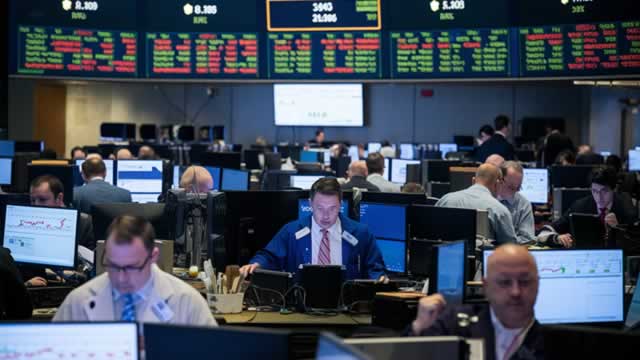
Savita Subramanian of Bank of America discusses market breadth and warns that while the market isn't a tech bubble, overly bullish sentiment and high earnings growth expectations for the S&P 500 could lead to disappointment. She suggests that bonds, with 10-year Treasuries yielding over 5%, may offer better risk-adjusted returns than equities over the next decade due to potential margin pressure and AI infrastructure bottlenecks.
- A lack of market breadth is not inherently alarming, but current sentiment is 'very bullish' with analysts forecasting 'all-time high' earnings growth for the S&P 500 over the next five years.
- Bonds are becoming 'interesting again'; the risk-return for a 10-year Treasury (over 5%) suggests they might outperform S&P 500 returns over the next decade.
- Concerns exist about margin pressure across sectors and bottlenecks in AI infrastructure, making a 'frictionless environment' unlikely and increasing the potential for disappointment.